A relationship with an adult child of an alcoholic: what can resurface and how to talk about it
23 September 2026 · Mgr Karolina Zawrotniak
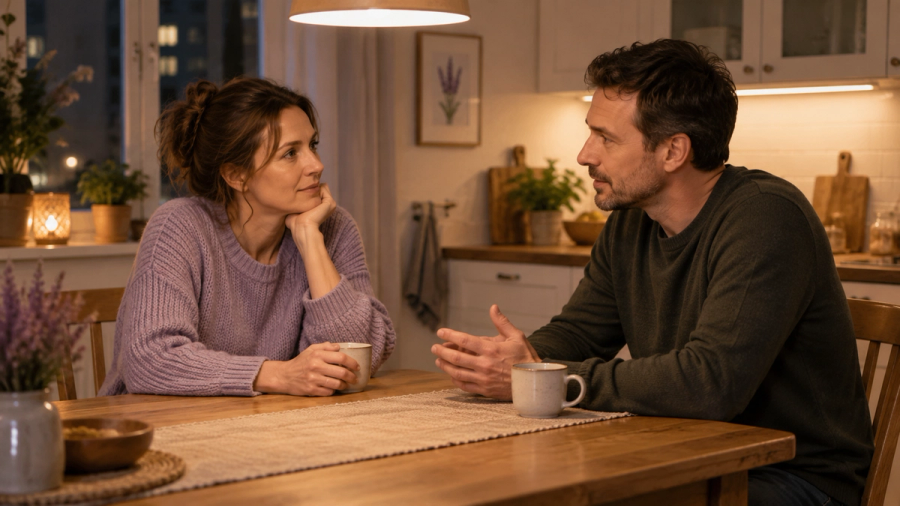
One of you grew up in a home where a parent's drinking shaped the life of the whole family. You are together now, and sometimes you can see that history coming between you: in an argument, at family celebrations, over a glass of wine at dinner, or when someone is late and not answering the phone.
In Polish this experience goes by the abbreviation DDA, for "adult children of alcoholics" (ACoA in English). It names an experience, not a diagnosis, and it does not decide whether your relationship will work. Childhood experiences can still affect how someone reacts to tension, closeness and uncertainty. Material from the Polish State Agency for the Prevention of Alcohol-Related Problems (PARPA) notes that such reactions show up particularly in close relationships and under stress. This article is for both sides: for the person who grew up in such a home, and for their partner.
What DDA means and how such experiences can shape adult life is covered in Adult children of alcoholics: how growing up with a parent's drinking can shape adult life. Here we look at what happens between two people.
Does a relationship with an adult child of an alcoholic have to be difficult?
No. In a review of research on adult children of alcoholics, Harter (2000) describes an increased risk of various difficulties, including in family relationships. None of them, however, appears in everyone from such homes, and none is specific to them. The author also points out that research offers little support for a single "ACoA syndrome" of the kind described in the clinical literature.
Research on relationships gives a similar picture. In a large US survey of families, people who grew up with a parent's drinking were less likely to marry, and their marriages were on average lower in quality and stability (Watt, 2002). In another study, 634 couples were followed through the first four years of marriage. The link between a parent's drinking and how people rated their own marriage appeared only in some combinations: it depended on the person's gender and on which parent drank (Kearns-Bodkin and Leonard, 2008).
Averages from large studies say nothing certain about one couple. What they do show is that if you recognise yourselves in any of the descriptions below, you are not unusual.
How can a childhood with a parent's drinking resurface in a relationship?
A child in a home where nobody knows what the evening will bring learns ways of getting through it. PARPA describes how these ways become fixed and kick in during adult life, even when nothing bad is happening. Below are a few situations in which this can show in a relationship.
Watching your partner's mood
She comes home from work quieter than usual. Her partner, who grew up with a drinking parent, is already reading her face and tone of voice at the door, asks "are you angry with me?" several times and looks for what they did wrong. For her this can be tiring, because ordinary tiredness after work turns into something that needs explaining. For the person with this history, it is a reflex from a time when an adult's mood decided how the evening would go.
Promises and lateness
A parent was supposed to come to the school play, supposed not to drink at Christmas, supposed to pick you up from training. The PARPA material lists broken promises among the frequent experiences of children from such families. In a relationship it might look like this: your partner texts that he will be home at six, it is twenty to seven and his phone is silent. For one person that is ordinary lateness. In the other, worry builds faster than they would like, and when he walks in there is an argument he does not understand.
Conflict as a threat
A raised voice, a slammed door, sometimes just "we need to talk" can trigger a reaction as if to danger. Some people give in and apologise before they understand what is going on. Others answer more sharply than the situation calls for, or leave the room. From the outside it looks like overreacting, though from the inside it is protection against something that really was dangerous once. If your arguments keep following the same script, we describe the mechanism in Constant arguing in a relationship: why you keep having the same fight.
Closeness that brings unease
Some people from such homes want closeness very much and fear it at the same time. When the relationship deepens, tension, mistrust or a need to pull back appear. PARPA calls this fear of closeness. Popular descriptions tend to show an adult child of an alcoholic as a woman who is overly dependent on her partner. In Watt's study, men from such homes more often showed the opposite pattern: distance rather than overinvolvement (Watt, 2002). Both reactions, clinging to a partner and keeping them at arm's length, can come from the same fear.
Your own needs last on the list
Someone who has looked after other people's moods since childhood may find it hard to answer "and what do you want?". They agree to plans they do not want, and weeks later resentment surfaces that their partner had no idea about. The partner then hears "you never ask me", although he did ask, and each time heard "I do not mind".
Control and a plan for everything
Predictability feels safe, so a person with this history may plan, check and keep track more than their partner. A sudden change of plans, or a trip organised at the last minute, can bring more unease than the situation seems to warrant. The partner sees control, while for the person with this history it is a way of keeping things from falling apart.
These are examples, not a checklist. Similar reactions happen to people from very different homes, and an adult child of an alcoholic may not recognise themselves in any of them.
Alcohol in your relationship today
A glass of wine with dinner, a beer at a friends' barbecue, a wedding. For one person these are ordinary situations. For someone who grew up with a drinking parent, the smell of alcohol, a voice changing after the second drink or laughter a notch too loud can bring on tension before they have had time to think.
It is better to talk about alcohol when nobody is drinking, rather than in the car on the way home from a party. Some questions that can help:
- What exactly is hard for me: alcohol itself, the amount, or how someone behaves after drinking?
- What do I need in that situation: to leave earlier, an agreed signal, a conversation the next day?
- What is each of us willing to agree to, and what not?
Agreements like these help both people know what to expect. They do not turn one of you into a guard who watches the other's drinking.
It is different when your partner's drinking is a worry in itself: they find it hard to stop, alcohol turns up more and more often, or rows follow it. That is a current problem, and it needs help of its own. In Poland, therapy at addiction treatment clinics is available both to people who drink and to their family members (PARPA).
Family holidays and visits to parents
For many people, family holidays and celebrations mean calm. PARPA points out that children from families with a drinking problem often experienced violence during holidays and birthdays too. An invitation to spend Christmas with your parents, perhaps in another country, can therefore bring tension weeks before December. That can be true even when the parent no longer drinks: Nacoa notes that the difficulties people carry from such homes can continue whether or not the parent is still drinking.
Agree on a plan before you go, not once you are there:
- how long you are staying and whether you stay overnight,
- what you will do if the parent starts drinking or the atmosphere turns unpleasant,
- what signal means "I need to leave",
- whether you are going at all this year.
A partner does not need to understand every reaction to help. It goes a long way if they stick to what you agreed and do not argue on the spot that "it is only one evening".
What can the partner of an adult child of an alcoholic do?
Do not diagnose
"You only react like that because of how you grew up", said in the middle of an argument, shuts the conversation down. Even if there is some truth in it, the other person hears that their emotions do not count because you know where they come from. Talk about the past when you are both calm, and in the words of the person whose history it is.
Ask instead of guessing
"What happens for you when I raise my voice?" gets further than "stop overreacting". The answer may surprise you. Sometimes it is not about the volume itself, but about the fact that in your partner's family home a raised voice meant a row was coming.
Predictability in small things
Text to say you will be late. If you break off a conversation, say when you will come back to it. For someone who grew up among broken promises, small things like these mean more than their size would suggest.
Do not take on the role of therapist
You can support your partner, but you cannot work through their childhood for them. If you see the whole relationship revolving around avoiding their tension while your own needs disappear from view, look after yourself as well. You can talk about it with your partner, or book a consultation for yourself.
What can the person who grew up with a parent's drinking do?
Name your reaction
"When you slam the door, I feel the way I did at home when Dad came back after drinking. I know you are not him. I need a short break before we carry on talking." A sentence like that does not make your partner responsible for the past, and does not pretend the reaction did not happen.
Separate "then" from "now"
A useful question: does what I feel fit what is happening now, or rather what used to happen? Your partner being late may simply be lateness. In the cognitive behavioural approach this is exactly what we work with: learning to notice and check automatic interpretations before they decide the reaction (Epstein and Zheng, 2017).
Talk about needs before they turn into resentment
If "I do not mind" is your most frequent answer, start with small things: which restaurant you prefer, whether you have the energy for guests today. Your partner cannot guess needs they never hear.
When is it worth looking for help?
A consultation is worth considering when:
- the same situations keep coming back despite attempts to talk,
- one of you is constantly watching their words so as not to set off the other's reaction,
- arguments about the past, parents or alcohol recur every few weeks,
- closeness has started to bring more tension than relief,
- you face a decision you cannot make together, for example about contact with family.
Sessions for the couple
If the difficulty is about what happens between you, start with couples therapy. The first session is a consultation and lasts 60 minutes. Each of you describes how you see the situation, and at the end you agree what you want to work on. We do not look for someone to blame, and we do not treat one person's past as the explanation for everything that happens in the relationship. What the first session looks like is described in What happens in couples therapy? Your first session, step by step.
You can book couples sessions with Karolina Zawrotniak, the author of this article. Karolina works with couples in a cognitive behavioural approach, at our practice in Poznań and online, in Polish and in English.
An individual consultation
If you are the one who grew up with a parent's drinking and you want to look at your own reactions first, you can start with a psychological consultation for yourself. At Oddech, Agnieszka Michalak works with people who grew up in families affected by alcohol or other kinds of dysfunction (DDA/DDD). She is a psychologist and a CBT psychotherapist in training, and she consults in Polish and in English. The session lasts 50 minutes and takes place at our practice in Poznań or online. You do not need to arrive with your story ready, or to decide whether the label fits you.
The partner of someone with this history can also come to a consultation for themselves, if they want to talk about what they are going through in the relationship.
If one of you starts regular individual psychotherapy, couples sessions are usually safer with a different person. Someone who has worked individually with one partner finds it hard to keep an equal distance from both.
When couples therapy is not the first step
There are two situations in which we do not start with couples therapy.
The first is an active addiction in one of you. We then decide case by case what comes first: sometimes it is addiction treatment, and sometimes you need a specialist who works with couples in exactly that area.
The second is abuse in the relationship, whether physical, psychological, sexual or economic. A joint session can increase the risk to the person experiencing abuse, because what they say in the room has consequences once they are home. We start instead with individual support or crisis intervention.
If you need help now:
- 112: the emergency number, when the situation is dangerous.
- 800 120 002: Niebieska Linia, the national helpline for people experiencing domestic abuse. Free, 24 hours a day. Consultations in English on Mondays, 6 pm to 10 pm.
- 800 70 2222: Centrum Wsparcia, the national crisis helpline for adults. Free, 24 hours a day, in Polish.
Common questions about relationships with adult children of alcoholics
How do I know whether my partner is an adult child of an alcoholic?
You do not need to establish that. It is not a diagnosis, and the person whose history it is will tell it best, if they want to. What is actually happening between you matters more than the label.
Does an adult child of an alcoholic need therapy before they can have a relationship?
No. Nobody has to be "fully worked through" to be in a relationship. Individual therapy can help someone understand their own reactions better, but it is not a condition of a close relationship.
Are people who grew up with a parent's drinking more likely to marry someone who drinks?
In a large Swedish study based on national registers, including medical and criminal records, people whose parent had a recorded alcohol use disorder were more likely than others to marry someone with the same diagnosis (Salvatore et al., 2019). Across the whole study group, such a diagnosis was recorded in about 2–3% of spouses, so this is a statistical association, not a rule. If your partner's drinking worries you, take it seriously and talk about it with a psychologist or at an addiction treatment clinic.
What if my partner does not want to talk about their childhood?
They do not have to. You can talk about what is happening now: a specific argument, holiday plans, drinking at a party. In couples sessions nobody is asked to talk about the past before they are ready.
Does couples therapy make sense if the difficulty seems to be about one person's past?
Yes. The history belongs to one person, but the reactions that come from it happen between you. In sessions we work on specific situations from your week and on how each of you understands them.
This article is for psychoeducational purposes. It does not replace a psychological consultation or an individual assessment of a particular couple's situation.
Sources
- Epstein, N. B., & Zheng, L. (2017). Cognitive-behavioral couple therapy. Current Opinion in Psychology, 13, 142–147. https://doi.org/10.1016/j.copsyc.2016.09.004
- Harter, S. L. (2000). Psychosocial adjustment of adult children of alcoholics: A review of the recent empirical literature. Clinical Psychology Review, 20(3), 311–337. https://doi.org/10.1016/S0272-7358(98)00084-1
- Kearns-Bodkin, J. N., & Leonard, K. E. (2008). Relationship functioning among adult children of alcoholics. Journal of Studies on Alcohol and Drugs, 69(6), 941–950. https://doi.org/10.15288/jsad.2008.69.941
- Nacoa (The National Association for Children of Alcoholics). Help and advice for adults.
- Państwowa Agencja Rozwiązywania Problemów Alkoholowych (PARPA). Wpływ doświadczeń z dzieciństwa w rodzinie z problemem alkoholowym na funkcjonowanie osoby w życiu dorosłym [The impact of childhood experiences in a family with a drinking problem on adult functioning]. Leaflet based on: Z. Sobolewska-Mellibruda, Psychoterapia Dorosłych Dzieci Alkoholików, IPZ, Warsaw 2011. National Health Programme 2016–2020. In Polish.
- Salvatore, J. E., Larsson Lönn, S., Long, E. C., Sundquist, J., Kendler, K. S., Sundquist, K., & Edwards, A. C. (2019). Parental alcohol use disorder and offspring marital outcomes. Addiction, 114(1), 81–91. https://doi.org/10.1111/add.14405
- Watt, T. T. (2002). Marital and cohabiting relationships of adult children of alcoholics: Evidence from the National Survey of Families and Households. Journal of Family Issues, 23(2), 246–265. https://doi.org/10.1177/0192513X02023002004
Read next

Mismatched libido in a relationship: when one partner wants sex more often
Different levels of desire do not automatically mean something is wrong with either partner. How to talk about sex, respect a refusal and consider what kind of support fits.
22 September 2026

Adult children of alcoholics: how growing up with a parent's drinking can shape adult life
Guilt after saying no, scanning other people's moods, finding it hard to rest. For some adults who grew up with a parent's drinking, these reactions share a background. What the term means, why it is not a diagnosis, and how to start without proving it was "bad enough".
21 September 2026

What happens in couples therapy? Your first session, step by step
A first couples session is a conversation about what happens between you, not a ruling on who is right. What the psychologist asks, what you do not need to prepare, and what to do if your partner is not convinced.
8 September 2026